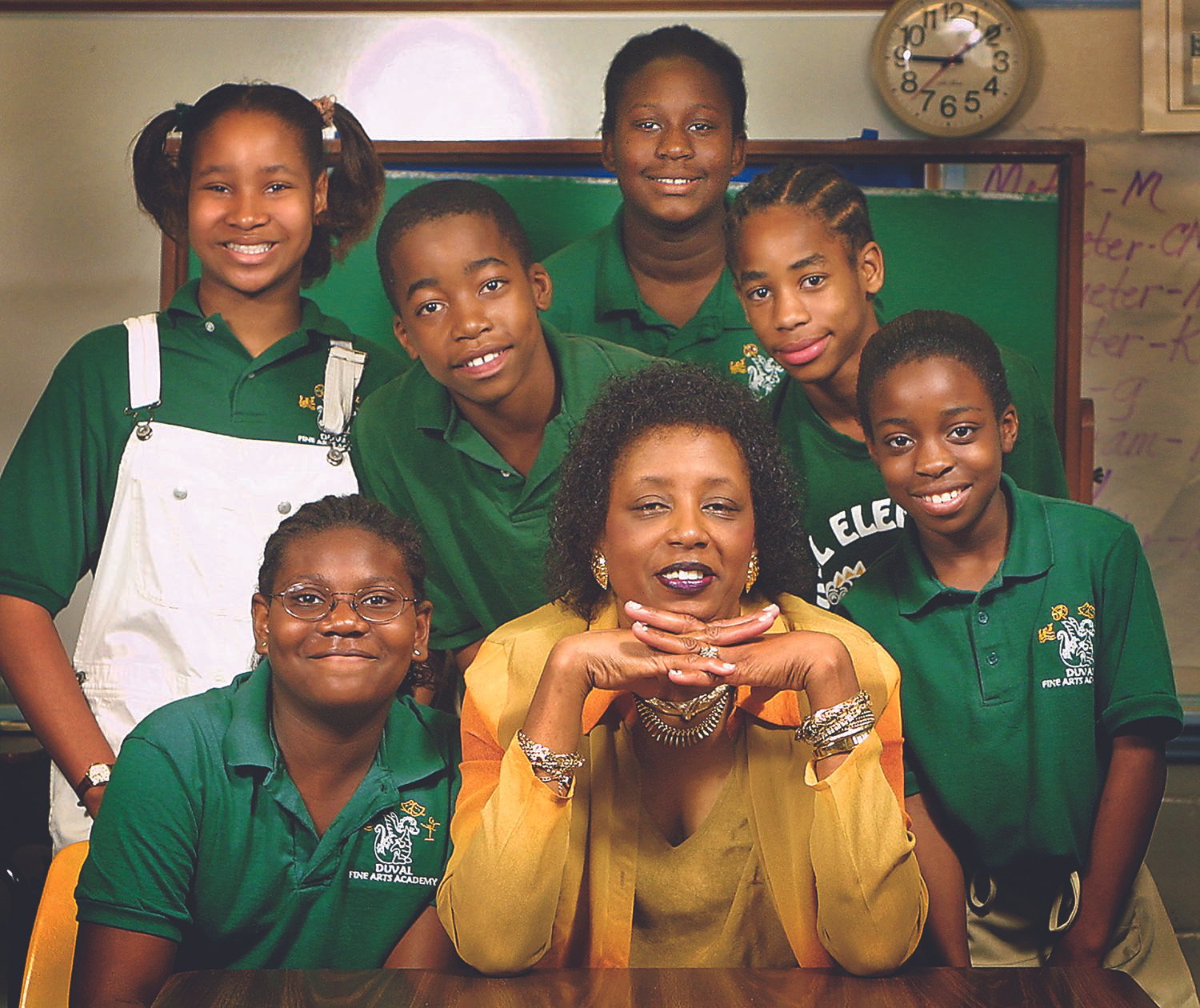
A revolutionary educator fought expectations and structural inequalities to show her students that success is possible, but that dedication came with deadly results.
Written, directed and produced by award-winning filmmaker Boaz Dvir, Class of Her Own follows a revolutionary educator’s fight to give her students a chance in a world ready to write them off. It shines a light on the disenfranchisement of Black Americans and the ways in which extraordinary individuals respond, often at great risk to their careers and wellbeing.
Film Synopsis
Gloria, an African-American single mother of two, could have gone anywhere to teach. But she chose to spend her entire career in the economically disadvantaged neighborhood in which she grew up, East Gainesville, Fla. During the 2002-03 school year, Gloria transformed from an ordinary teacher into a trailblazer. She used hip hop, dance, call-and-response and other innovations to lead the elementary school students to the academic Promised Land.
She changed in reaction to her school failing its high-stakes state standardized test. Duval was the district’s only elementary school that flunked the FCAT (Florida Comprehensive Assessment Test). As a result, Gloria and her colleagues faced major consequences, including a budget freeze and the threat of a shutdown. The state and the school district pressured Gloria and her colleagues to strictly follow the prescribed curriculum and Pacing Guides. They imposed these cookie-cutter directives on impoverished and affluent communities alike, whether they work or not. Gloria protested that doing more of the same would yield more of the same results.
At the same time, Gloria realized she and her colleagues had been letting down their students all those years by aiming too low. She felt responsible for the fact that too few of them went on to college while too many ended up behind bars or six feet under. As the sun crept up on a sleepless night, it dawned on Gloria that the only way out is up. She rejected the excuse that her students can only achieve so much because most of them came from poor, broken households. She set out to reinvent herself to meet her students where they were.
Gloria created a new curriculum from scratch to make the lessons relevant to her students. Recognizing that rhythm and repetition help children grasp and memorize complex concepts, she experimented with music and movement. To make her lessons stick, Gloria used hip hop, dance, R&B, gospel, and church-like chanting. She wrote original songs and choreographed geometrical movements. Instead of focusing on her students’ shortcomings, Gloria bolstered their strengths. As University of Florida Professor ELIZABETH BONDY observed: “Gloria did not study guidelines. She studied her students”. This led Gloria to be more tough on them. At the same time, she helped them overcome challenges in and out of school. If their worn-out sneakers no longer fit, a new pair appeared out of nowhere.
Duval Principal LEE MCNEALY became a believer. Taking a huge risk, she asked Gloria to teach math and reading to all of Duval’s FCAT-taking students (third, fourth, and fifth graders), and coach her colleagues. Gloria went further. She pulled all-nighters turbocharging her lesson plans and taught evening courses to parents who wished to reinforce the learning at home or just keep up with their kids.
The grueling workload took a toll on her health. Family and friends begged Gloria, a diabetic, to rest, exercise, eat right and see a doctor. But she had other priorities. One afternoon, she collapsed on her classroom floor and ended up in the hospital. It was a wake-up call she dismissed. As soon as the doctor reluctantly discharged her, she headed right back to school. Sacrificing her health, Gloria morphed into a matchless master. In one year, she propelled Duval from an F to an A.
For the following four years, Gloria keeps Duval at the top of the state’s learning gainers, outscoring even the elementary schools in the University of Florida administrators and professors’ wealthiest neighborhoods. She created a Math Team that traveled around the South presenting her methods at schools and conferences. Gloria became the talk of the scholarly world and gave her students the tools and confidence to succeed in school—and beyond.
But Gloria’s selflessness caught up with her. A week after receiving a prestigious Kellogg Foundation grant to share her breakthroughs nationally, she suffered a diabetic stroke. Gloria went into a coma. A couple of days later, she was pronounced dead. Gloria’s fifth graders had made the highest math learning gains in the whole state. The year after her death, the community held high hopes for Duval’s continued success. Gloria’s achievements brought it a great deal of new resources.
But without its star teacher, the school failed the FCAT. It never regained its academic footing, closing seven years later. Class of Her Own is about building a meritocracy for all Americans, the incredible dividends that come from investing in education, and the redemptive quality of blazing new trails.
Watch the Trailer

About the Director
Award-winning filmmaker Boaz Dvir tells powerful true stories of ordinary people who face extraordinary circumstances and transform into trailblazers. They include an average schoolteacher who emerges as a disruptive innovator and a national model (Class of Her Own); a World War II flight engineer who transforms into the leader of a secret operation to prevent a second Holocaust (A Wing and a Prayer); an uneducated truck driver who becomes a highly effective child-protection activist (Jessie’s Dad); and a French business consultant who sets out to kill former Nazi officer Klaus Barbie and ends up playing a pivotal role in one of history’s most daring hostage-rescue operations (To Kill a Nazi).
Dvir’s films have been distributed by PBS, The New York Times, Hulu, and Amazon Prime, and screened worldwide at venues including Columbia University’s Global Center in Paris and the Museum of Tolerance in Los Angeles. He has presented and lectured at universities, schools, museums, and other venues around the U.S.
A journalism professor at Penn State, Dvir directs the university’s Holocaust, Genocide and Human Rights Education Initiative and developed a journalism ethics syllabus for Harvard’s Kennedy School. He has written for TIME, Newsday, The Miami Herald, and many other publications, and produced the New York Times documentary short “How Special Ops Became Central to the War on Terror.” His documentary short, El País de la Eterna Primavera, screened at 20 film festivals and won multiple awards.
Dvir’s acclaimed nonfiction book “Saving Israel” (Rowman & Littlefield, 2020) was praised by the Washington Times as “fascinating and dramatic.”
Earlier in his career, Dvir served as an editor at the Jacksonville Busiss Journal and contributed to “Homegrown in Florida” alongside Michael Connelly, Carl Hiaasen, and Tom Petty. His work has been featured in Forbes, The Guardian, Haaretz, and MSNBC.